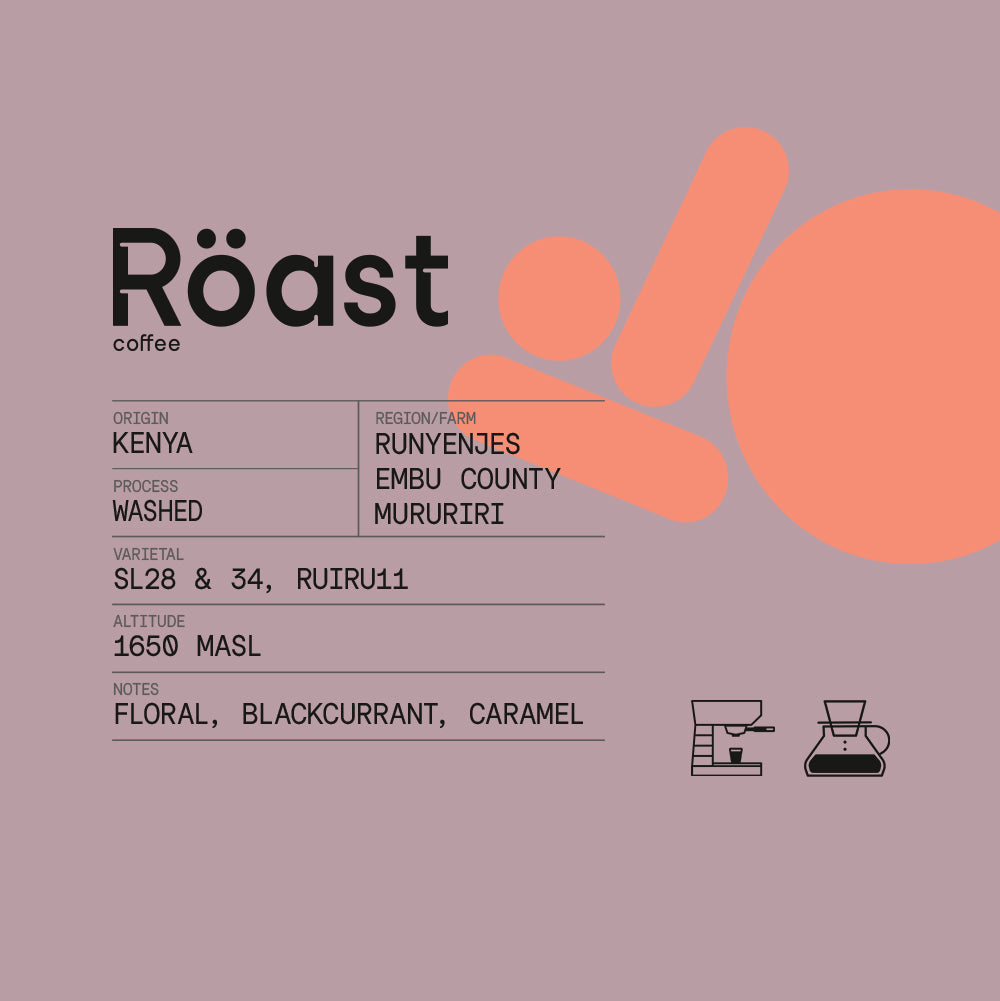
Kenya's coffee cultivation dates back to the late 19th century: the high altitude and volcanic soil provide unparalleled conditions for vibrant, acidic, and distinctive coffees.
The Mururiri PB originates from Central Kenya, in Embu County, where over 700 dedicated smallholder farmers deliver their hand-picked cherries to the Mururiri washing station, operated by the Kiangawa Cooperative. The farms are located at an altitude of 1600–1800 meters, home to classic Kenyan varieties (SL 28, SL 34) and newer cultivars (Ruiru 11, Batian).
Flavor profile and character
Typical of the region and the meticulous washed process, the cup is dominated by bright, lively citrus notes, elegant fruitiness, complex layers, and a clean, long-lasting finish.
Processing method (Fully Washed)
Hand sorting: After harvest, thorough hand sorting at the wet mill ensures that only perfectly ripe cherries are processed.
Pulping: The fruit pulp is removed using a disc pulper.
Fermentation: The beans ferment in tanks for 14–16 hours, depending on ambient temperature, until the pectin layer is completely broken down.
Washing with fresh mountain water: The coffee is thoroughly washed with fresh water from mountain springs and collected rainwater, guaranteeing a crystal-clear flavor profile.
Slow drying on African beds: The parchment coffee is dried on raised African drying beds for 14–21 days. The beans are protected from excessive heat and strong sunlight during the day with shade nets, preserving the coffee's most delicate internal aromas.
The Embu region of Kenya is located on the southeastern slopes of Mount Kenya, making it one of the country's most uniquely endowed areas for coffee cultivation. The mountainous microclimate is exceptionally favorable for the slow maturation of coffee cherries: altitudes predominantly range between 1500 and 1900 meters above sea level, resulting in high daytime temperatures and cool nights. This significant temperature fluctuation allows for a high concentration of sugars and organic acids to accumulate in the coffee beans.
The region's soil is particularly nutrient-rich, deep red volcanic earth, boasting excellent water retention capacity and an ideal mineral composition. Embu receives abundant and balanced annual rainfall, defined by two main rainy seasons. This dual rainy season enables two distinct harvest cycles: the main harvest typically runs from October to December/January, while the smaller, so-called "fly crop" harvest falls in June and July.
The production structure is almost entirely based on smallholder communities. Farmers hand-pick the ripest cherries from their small plots (shamba), which are then transported to local washing stations (factories). The traditional, meticulous washed processing method used here, along with long sun-drying on raised beds, brings out the region's characteristic exceptionally clean, vibrantly fruity, and blackcurrant flavor notes, combined with a syrupy body.
Serving suggestion
Input quantity
18g
Output quantity
40g
Time
25 - 30 s
Water temperature
92 °C
100% Single Origin Arabica coffee, recommended as an espresso or milk-based drink.
Roast: espresso, filter
Moka pot preparation:
For a 2-cup moka pot: use 10g of ground coffee with 100g of hot water.
The above recipe is just a recommended preparation method; feel free to change it and experiment with the settings to suit your equipment and taste, but it is important to always use filtered water when making coffee!
Choosing a selection results in a full page refresh.